Euro area banks tightened loan standards for firms and households in second quarter, ECB survey finds
The European Central Bank said euro area banks reported net tightening of credit standards on business loans, mortgages and consumer credit in the second quarter of 2026, and expect to tighten further in the third quarter.

Euro area banks tightened their credit standards across every major loan category in the second quarter of 2026, according to the July bank lending survey published by the European Central Bank on July 21.
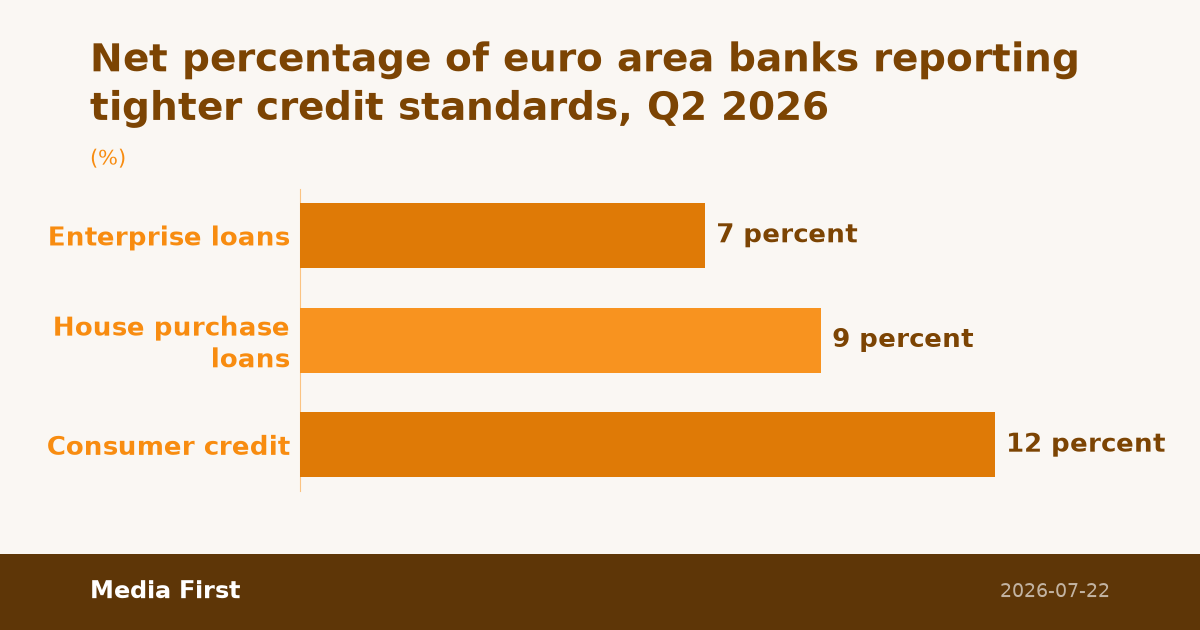
The net percentage of banks reporting tighter standards was 7 percent for loans to enterprises, 9 percent for house purchase loans and 12 percent for consumer credit and other lending to households, the ECB said. For business lending, the outcome was considerably milder than banks themselves had predicted: in the previous survey round they had signalled a net tightening of 19 percent.
The ECB attributed the tightening on business loans mainly to banks’ perception of risks tied to the economic outlook and to their reduced risk tolerance, adding that vigilance over geopolitical and energy-related risks was maintained. Lower risk tolerance and higher risk perceptions were also the main drivers for both mortgages and consumer credit. Terms and conditions on loans actually granted tightened in all segments, the survey said, chiefly because of higher lending rates, and rejection rates rose on a net basis for every category of borrower, with the increase in consumer credit larger than for firms or mortgages.
On the demand side, the picture was less weak than banks had expected. Demand for business loans rose on a net basis by 3 percent, against a previous expectation of minus 10 percent, supported by inventory and working capital needs, fixed investment financing at large firms, and debt restructuring and refinancing. Mortgage demand fell by a net 15 percent, better than the minus 20 percent expected, while consumer credit demand fell by 2 percent against an expected minus 9 percent. The ECB said falling mortgage demand reflected weaker consumer confidence, changes in interest rates and a deteriorating housing market outlook, while for consumer credit the order of importance was lower consumer confidence, subdued spending on durable goods and interest rate changes.
Banks reported that non-performing loan ratios continued to weigh on credit standards, with a net impact of 6 percent for business lending, up from 5 percent in the previous quarter, and 10 percent for consumer credit, up from 7 percent. For housing loans the effect was minus 1 percent. Access to retail funding, debt securities and money markets deteriorated slightly in the second quarter, while securitisation was broadly unchanged.
The survey’s semi-annual sectoral questions showed standards tightening in most economic sectors in the first half of 2026, most markedly in the automotive industry and in energy-intensive manufacturing. Tightening in commercial real estate was the smallest since the first half of 2021. Services excluding financial services and real estate was the only sector where standards were broadly unchanged and the only one where loan demand increased; net declines in demand were largest in car manufacturing and construction.
Climate-related questions pointed in two directions. The ECB said climate factors eased credit standards and supported demand for lending to green firms and to companies making progress in their green transition, while working in the opposite direction for high-emission firms without adequate transition plans. Physical risk was the largest tightening factor, with firm-specific transition risk growing in importance. Standards eased and demand rose for buildings with strong energy performance or ambitious energy targets, and tightened for poorly performing buildings.
Looking ahead, banks expect credit standards to tighten further in all loan categories in the third quarter of 2026, with housing loan demand falling again and consumer credit demand unchanged. Access to retail, money market and debt securities funding is expected to worsen further, with the deterioration in retail funding projected to be the largest since the third quarter of 2023, while securitisation is seen as unchanged. For the second half of 2026, banks anticipate additional tightening in most sectors alongside a recovery in demand for residential real estate loans.
The bank lending survey is a quarterly exercise conducted by the Eurosystem to track lending behaviour in the euro area, published in January, April, July and October and addressed to senior loan officers at about 150 banks. The July round covered 159 banks with a 100 percent response rate and was conducted between June 15 and June 30, 2026. Net percentages are calculated as the difference between the share of banks reporting tightening and the share reporting easing.