Korean religion is emptying out and nothing has replaced it
Fewer than half of Koreans now claim a religion and barely a fifth of people in their twenties do, ending a growth era that lasted half a century and leaving the community functions of religious life unfilled.
South Korea’s census asked about religion for the last time in 2015, and the answer marked a turn. Among respondents, 43.9 percent reported having a religion, down from 52.9 percent a decade earlier — the first count in which the non-religious were a clear majority. The internal composition moved too: Protestants at 19.7 percent, Buddhists at 15.5 percent, down sharply from over 22 percent in 2005, and Catholics at 7.9 percent.
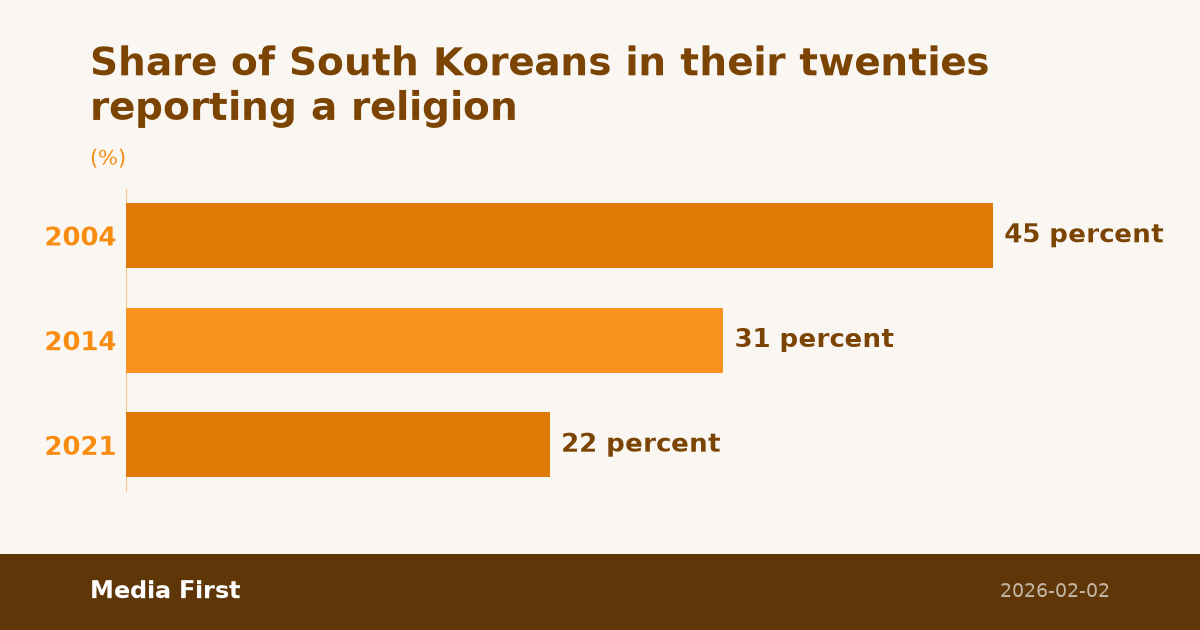
Survey work since has extended the line. Gallup Korea has run a periodic study of religious life since 1984, allowing a consistent comparison across four decades. Its 2021 round found 40 percent of adults reporting a religion, against 50 percent in 2014 and 54 percent in 2004. The generational gradient inside that figure is the more striking number: among people in their twenties, the share fell from 45 percent in 2004 to 31 percent in 2014 to 22 percent in 2021. A decline driven by cohort replacement rather than by adults leaving is a decline with momentum, because the arithmetic keeps working after the trend stops.
The Protestant experience explains the shape of the curve. Korean Protestantism grew explosively from the 1960s through the 1980s, in step with urbanisation: churches supplied arriving migrants with networks, welfare, child care and a moral vocabulary for a society being rebuilt at speed. The megachurch was the institutional form of that function, and Seoul produced the largest congregations in the world. Growth flattened in the 1990s, roughly when internal migration did. Since then its public standing has been eroded by disputes over hereditary succession of large pulpits, financial opacity and controversies over gatherings — trustworthiness surveys run by Protestant reform organisations themselves have repeatedly returned figures near or below 20 percent.
Buddhism’s response has been repositioning rather than defence. The templestay programme, launched in 2002 around the football World Cup and run by the largest order’s cultural arm, converted monasteries into short-stay retreats and has drawn millions of participants, most without doctrinal affiliation. It is best understood as a wellness and heritage product that keeps temples solvent and visible while affiliation falls. The order has been comfortable with cultural crossovers that would have been unthinkable a generation ago, including a monk performing as a club DJ to sizeable audiences in 2024.
Catholicism has held its share better and polls as the most trusted of the three, though its practice rate — the proportion of registered members attending regularly — has drifted well below its membership, and its congregations are ageing. Across all three traditions the pattern is the same: institutions retaining assets, buildings and social legitimacy while losing the flow of new adherents that funded them.
The interesting question is what happens to the functions. Religion in industrialising Korea was not primarily a set of beliefs; it was a standing weekly gathering, a calendar, a source of unpaid mutual aid, and the main non-kin community most adults belonged to. The state absorbed the welfare part as public provision expanded. The rest has partly moved into paid and app-mediated form: hobby-meeting platforms, subscription book clubs, gyms and running crews that supply exactly the pattern of recurring, low-commitment, non-work contact that congregations once did — and charge for it. The substitution is real but incomplete, because a paid community sheds its members when they stop paying, and because it selects for those who can.
That gap lands on a household structure that has changed at the same time. Single-person households became the most common type in Korea, passing 35 percent of all households by 2023, and single-person households are precisely the ones for whom a standing weekly gathering is hardest to arrange and most valuable to have. Korea’s secularisation is unusual mainly in its speed — European versions took generations — and its slower consequences are institutional: the schools, hospitals and welfare agencies religious organisations built during the growth years still exist, funded by a membership no longer arriving.