Why hiking became middle-aged Korea's default social institution
Mountains ring nearly every Korean city, and over three decades they became the cheapest, most socially legible way for middle-aged Koreans to exercise, network and spend money on gear.
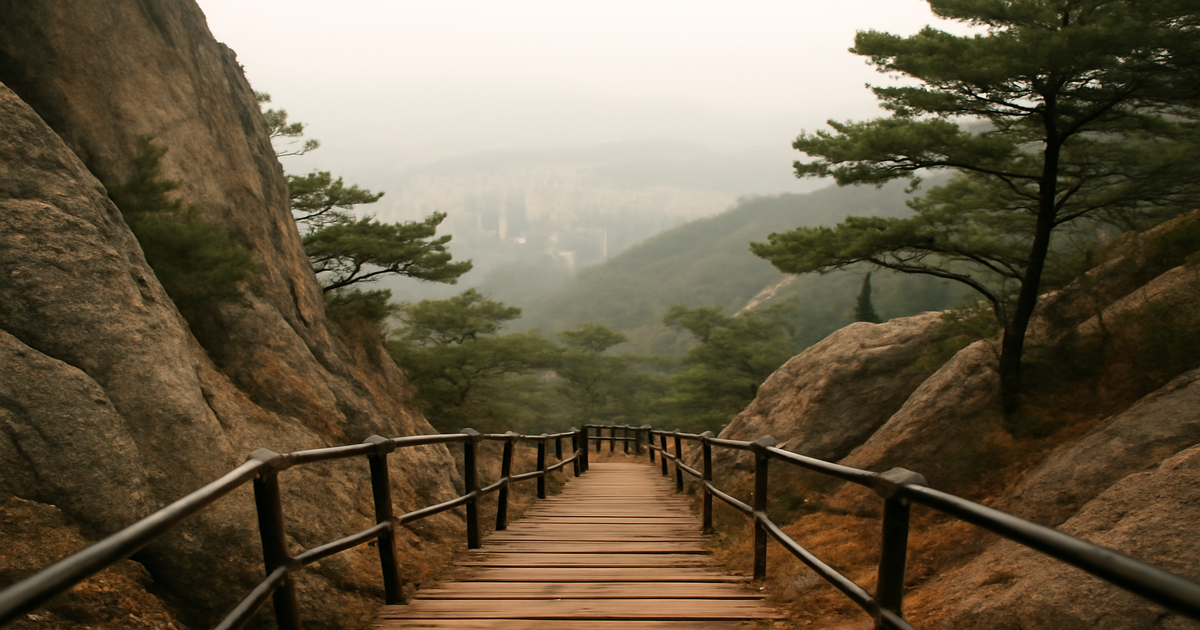
Roughly seven-tenths of the Korean peninsula is mountainous, and the ranges do not politely stop at the city limits. Seoul is ringed and penetrated by them — Bukhansan to the north, Gwanaksan to the south, Inwangsan and Namsan inside the old walls — and most provincial cities have their own equivalent, a granite hill twenty minutes from a subway station or a bus terminal. This is the physical precondition for everything else. In a country where private gardens are rare, apartment complexes dominate, and open flat land is expensive and commercially spoken for, the mountain is the only large, free, unprogrammed space available to an ordinary adult. Hiking in Korea is less a wilderness pursuit than a form of urban recreation that happens to involve elevation gain.
The generational skew has clearer causes than simple taste. Koreans now in their fifties and sixties came of age in a period of compressed industrialization when leisure infrastructure barely existed and disposable income arrived late. Golf carried a country-club price tag, tennis and swimming required booking and fees, and gyms were sparse outside the largest cities. Climbing a hill on Sunday morning cost a bus fare. That habit hardened into identity as the same cohort aged into the years when doctors start mentioning blood pressure and cholesterol, and when knees still work but joints reward low-impact, self-paced effort. The phased introduction of the five-day workweek in the mid-2000s handed this group a second free morning, and a great deal of it went uphill.
What made hiking stick, though, was that it solved a social problem rather than only a physical one. Korean adult life runs on organized groups — school alumni associations, hometown associations, church committees, workplace clubs — and each needs a recurring activity that is cheap, inclusive of varying fitness levels, and conducive to talking. A four-hour ridge walk is nearly perfect for this. It generates hours of side-by-side conversation without the forced intimacy of a dinner table, it accommodates a straggler, and it ends at a trailhead restaurant where the group eats pajeon and drinks makgeolli, which is the actual point for a fair share of participants. The sanak-hoe, or mountaineering club, became a standard organ of corporate and civic life precisely because it converted obligation into something that felt like health.
Gear spending followed, and then overshot. From the late 2000s into the early 2010s Korea sustained an outdoor apparel market extraordinarily large for its population, supporting domestic brands alongside licensed foreign labels, all competing on Gore-Tex membranes, seam-taping and increasingly aggressive color. The logic was social as much as technical: in a group activity where everyone is visible for hours, a jacket is a legible statement about seriousness and solvency, and there is no elegant way to hide an entry-level shell on a ridgeline. The market eventually saturated, as such booms do, and brands spent the second half of the 2010s retreating toward everyday athleisure. But the cultural residue stayed. Full technical kit for a two-hour walk on a well-maintained path remains unremarkable, and hiking clothes long ago migrated into general daytime wear for older Koreans.
The pastime also carries a quieter function around retirement. Korean men in particular often exit long-tenure employment earlier than they expect, and lose in a single week the institution that supplied nearly all their non-family relationships. Mountain clubs absorb some of that displacement, offering scheduled obligation, a hierarchy that is achievable rather than assigned, and a reason to leave the apartment before nine. Middle-aged women’s hiking groups, often organized through neighborhoods or churches, serve an analogous purpose against a different kind of isolation.
More recently the demographic has widened. Gentler dulle-gil circuit trails, popularized by the Jeju Olle routes and copied around national parks, opened the activity to people uninterested in summits, while younger hikers have rebranded steep city peaks as photogenic outdoor gyms and organized themselves into crews that function partly as social scenes. The gear, the group and the post-hike meal have carried over almost unchanged. What Korea’s hiking culture ultimately demonstrates is how thoroughly a nation will build its leisure around whatever the landscape and the working calendar leave available.