Korean families are quietly renegotiating what the holidays require
The ancestral rite at the centre of Korea's biggest holidays has been formally simplified by the Confucian body that codified it, and households are taking the permission further than the guidance intended.
Twice a year, at the lunar new year and at the autumn harvest holiday, South Korea empties its cities into its provinces. Transport ministry planning documents for these periods routinely anticipate tens of millions of journeys across a few days, on a peninsula of 51 million people. The occasion is nominally a rite: an ancestral offering performed on the morning of the holiday at the home of the eldest male line, with a table of prescribed foods, placement and sequence.
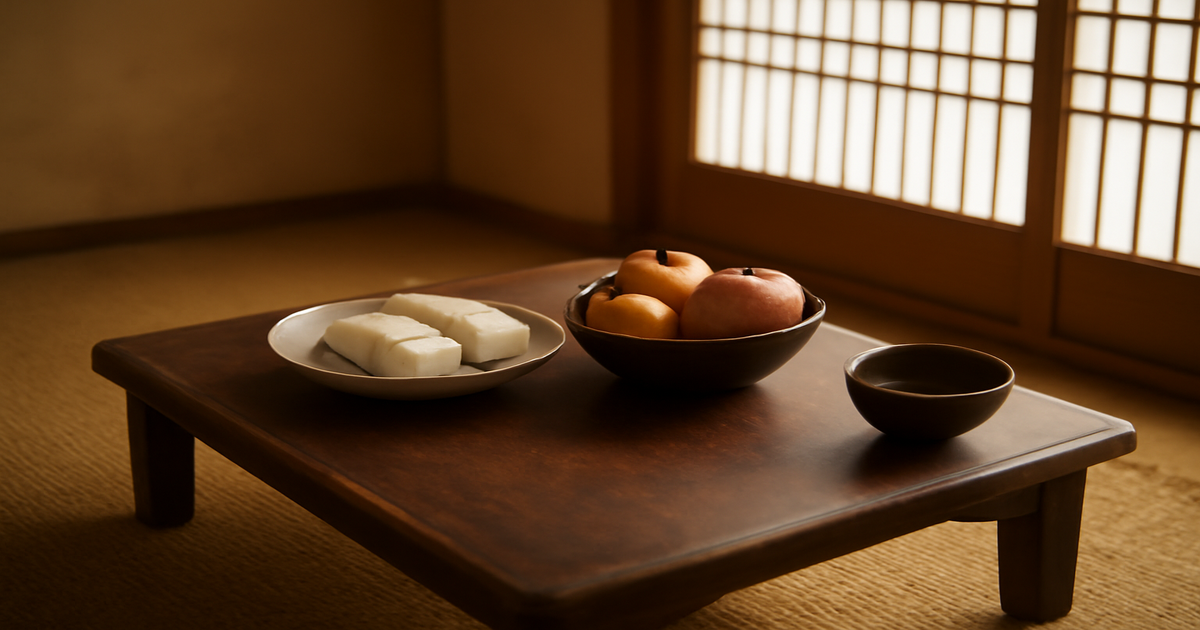
In September 2022 the ritual committee of the Sungkyunkwan, the Confucian institution that has functioned as the authority on such matters since the Joseon period, published a simplified standard. It said that six categories of food are sufficient — rice cake soup or songpyeon, seasoned vegetables, a grilled item, kimchi, fruit and drink. It said the fried and pan-battered dishes that consume most of the preparation labour are not required, and never were required by the classical texts. It said a photograph may stand in for the written spirit tablet, and that the order of dishes on the table is not doctrinally fixed. The content mattered less than the source. For decades, households arguing about how much was enough argued against an unfalsifiable claim that tradition demanded more; the body most entitled to make that claim withdrew it.
The labour behind the table is the reason the guidance registered. Preparation has fallen overwhelmingly on women in the household of the husband’s family, an arrangement that generated the durable Korean phrase for holiday stress and newspaper features on post-holiday marital friction dating back to the 1990s. Successive government family surveys have recorded declining agreement with the proposition that ancestral rites should be continued as performed, and the decline is steepest among younger married women — the people who would perform them.
Households had in practice begun negotiating before the permission arrived. The most visible exit is travel. The holiday periods now produce records at Incheon Airport rather than only on the expressways, a pattern that became conspicuous when a temporary public holiday extended the 2023 autumn break to six consecutive days and outbound bookings filled months ahead. A holiday defined by return to the ancestral hometown is being spent, by a growing minority, outside the country entirely.
The commercial layer has adapted with characteristic speed. Catering firms sell complete rite tables for delivery; agencies will visit and tend a family grave on behalf of descendants who do not travel; hotels market holiday packages to families who want the gathering without the kitchen. The gift trade tells a parallel story about who the holiday is actually for: the ceiling on agricultural and fishery gifts under the anti-graft act was raised to 300,000 won for holiday periods in 2023, a legislative act that only makes sense because a large share of holiday gifting is institutional rather than familial. Retailers have accordingly split their ranges into premium sets aimed at that trade and value sets aimed at households.
Underneath all of it is a structural fact that no amount of ritual reform addresses. Single-person households passed 35 percent of all Korean households by 2023, and the extended family that the rite presupposes — several married sons, their wives, and a house large enough — describes a decreasing share of the population. A ceremony that assigns roles by seniority and gender in a patrilineal line becomes unperformable, not merely burdensome, when the line has one member.
What is being abandoned, then, is the obligation rather than the occasion. Surveys still find most Koreans intending to see family at the holidays, and the food, the travel and the awkward questions about marriage and salary persist without the rite. That is a meaningful change in kind. A gathering enforced by kinship duty and a gathering that people choose are different institutions with different failure modes, and the second one has to be worth attending on its own terms.