The company drinking session is losing its grip on Korean offices
Korean alcohol consumption has fallen below the OECD average and the compulsory after-work team dinner has been unbundled from employment by four separate legal and social changes.

For most of the past half century the Korean workplace came with an evening attached. The team dinner — hoesik — was scheduled by the manager, attended by everyone, and sequenced: a first round over grilled meat and soju, a second round at a bar, sometimes a third. Its defenders described real functions. Hierarchy loosened enough for junior staff to say things they could not say at their desks; information that never entered a document circulated; attendance itself served as a loyalty signal in organisations that promoted on judgment rather than metrics. Its cost fell on anyone with caring responsibilities, anyone who did not drink, and anyone whose tolerance was low enough to make the ritual a health risk rather than a social one.
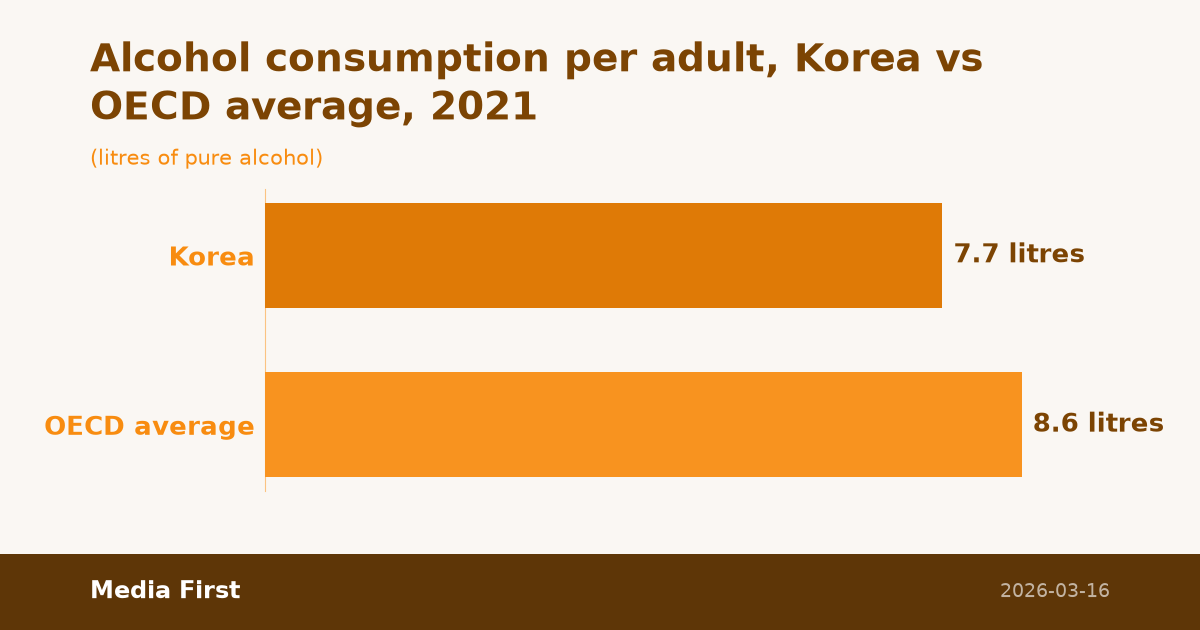
The aggregate drinking numbers have been moving for a while. OECD health statistics put Korean consumption at around 7.7 litres of pure alcohol per adult in 2021, below an organisation-wide average near 8.6 — a reversal of the country’s long-standing reputation, and consistent with a decline that national health and nutrition surveys have tracked in men’s high-risk and monthly binge drinking through the 2010s. Total spirits shipments have trended down over the same span. The reputation lags the data by roughly a decade.
Four institutional changes did most of the work, none of them aimed at hoesik directly. The statutory working week was cut to 52 hours from 2018, and the labour ministry’s implementing guidance clarified that company dinners generally do not count as working time — a ruling that cut both ways, since it denied employees compensation for the evening while making it legally awkward to treat attendance as compulsory. Workplace harassment provisions entered the Labour Standards Act in 2019, giving coerced drinking a name and a complaint procedure. Drink-driving penalties were sharply tightened across 2018 and 2019, removing the assumption that a senior colleague would drive home afterwards. And the pandemic suspended the practice entirely for roughly two years, which turned out to matter most: a norm sustained by the fact that everyone attends is fragile once nobody has attended for a while.
What returned was smaller. Recruitment-firm surveys since 2022 have consistently found majorities preferring a single round, an earlier finish, or a lunchtime format, and the second round in particular has not recovered its former status as the default. Managers have adapted by moving the budget to daytime: team lunches, coffee, activity outings, occasional workshops.
The drinks industry read the same signals. Non-alcoholic beer moved from a curiosity to a shelf category, with the major domestic brewers all launching zero-alcohol lines around 2020, and industry estimates place the segment at tens of billions of won a year against something close to nothing a decade earlier. Low-alcohol spirits, flavoured products aimed at solitary drinking at home, and the general normalisation of drinking alone have all grown in the same period. Consumption has not so much fallen as relocated — out of the mandatory group setting and into a discretionary private one.
The replacement raises an equity question that cuts against the easy reading. Hoesik excluded people, but the informal information it carried was at least distributed to everyone in the room. When that channel moves to messenger threads, lunches and whoever happens to be near the manager’s desk, access narrows in a way that is harder to see and impossible to opt into. Organisations that removed the drinking without deliberately rebuilding the information flow have generally not replaced the function; they have privatised it.
None of this amounts to the end of Korean drinking culture. Soju remains the volume leader by a wide margin, and the industries built around evening entertainment have not closed. What has changed is narrower and more consequential: the obligation has been separated from the employment relationship. A drink after work is becoming something colleagues choose rather than something a job includes, which is a smaller cultural shift than it sounds and a larger labour one.