How Korea sets its minimum wage each summer
A 27-member commission of labour, business and public-interest representatives negotiates a single national wage floor every year, and the process has become one of the country's most closely watched economic rituals.

Every June and July, one committee meeting dominates Korean economic news. The Minimum Wage Commission, a tripartite body of 27 members — nine from labour unions, nine from employer associations and nine public-interest members appointed by the government — must agree on the hourly wage floor for the following calendar year, with the figure announced by early August so it can take effect on 1 January. The structure dates to the Minimum Wage Act’s implementation in 1988 and has changed little since.
In practice the arithmetic of the committee decides the outcome. Labour and business open with figures far apart, narrow them across several rounds, and almost never converge. The nine public-interest members then propose a range, and when no agreement emerges the decision goes to a vote in which they hold the balance. Walkouts by one side or the other are a recurring feature, and several recent settlements have been passed with one bloc absent. The formal negotiation is genuine, but the appointed members’ judgment usually determines the number.
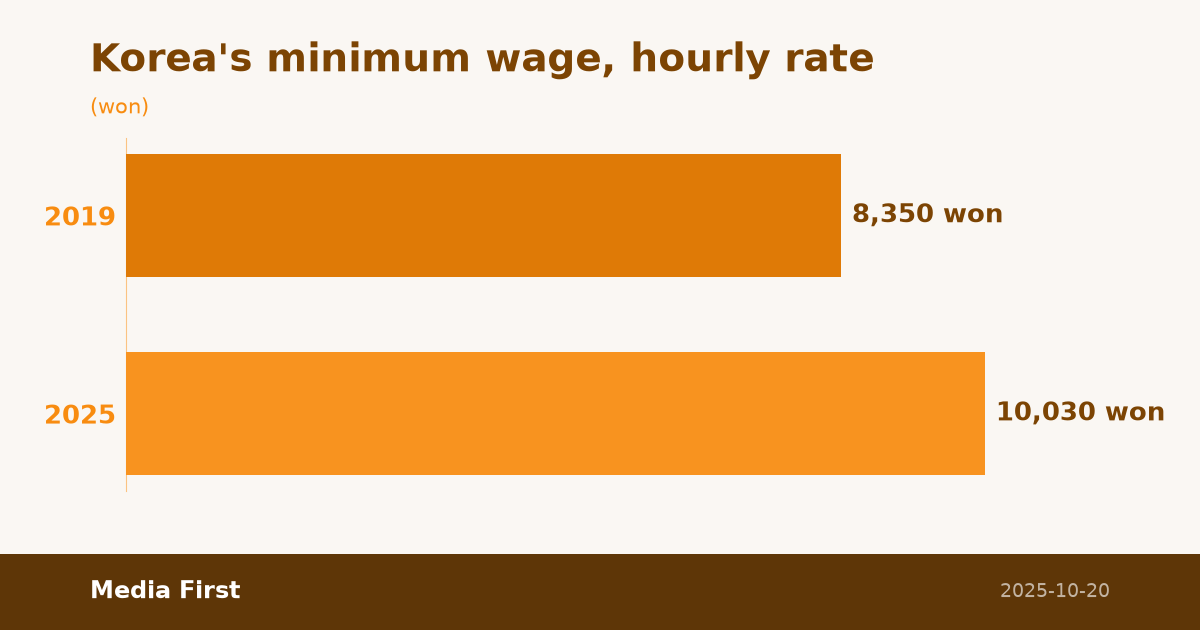
Two years made the process nationally contentious. The floor rose 16.4 percent for 2018, to 7,530 won an hour, and a further 10.9 percent for 2019, to 8,350 won — the largest consecutive increases since the early 2000s, delivered on an explicit policy of income-led growth. The economic assessment that followed was genuinely contested. Studies pointed to compressed wage inequality and higher earnings for those who kept their jobs; others found reduced hours and employment in small-scale retail and food service, the sectors where the floor binds hardest. Increases afterwards were markedly smaller, including a 1.5 percent rise for 2021 during the pandemic, the smallest on record.
The trajectory since has been incremental. Increases of around 5 percent for 2022 and 2023 were followed by 2.5 percent for 2024, taking the floor to 9,860 won, and 1.7 percent for 2025, which carried it past a symbolic threshold to 10,030 won an hour. Measured over the decade to 2025, the cumulative rise is close to 80 percent, well ahead of consumer price inflation over the same period and among the steeper trajectories in the OECD, though Korea’s floor remains below those of western European economies in absolute terms.
Two structural arguments recur each year. The first concerns the weekly holiday allowance, a Korean provision requiring paid rest for workers meeting a weekly hours threshold, which raises the effective hourly cost above the headline figure — employers argue the true floor is therefore around a fifth higher than the number announced, and want the allowance folded into the calculation. The second is differentiation. The Minimum Wage Act has always permitted different rates by industry, but the provision has gone unused since the scheme’s first year; employer proposals to apply lower rates in accommodation, food service and care work have been tabled repeatedly and voted down each time, on the argument that a differentiated floor would stigmatise the affected occupations.
Regional differentiation is raised less often but is arguably the sharper question, given the gap between living costs in Seoul and in provincial cities. It runs into the same objection from the opposite direction: a lower rural floor could accelerate the outflow of young workers from regions already losing population.
What makes the annual negotiation heavier than the numbers suggest is who is on both sides of it. Korea’s minimum wage binds most directly on small proprietors — the roughly 5.7 million self-employed counted by Statistics Korea, many operating on thin margins in the same retail and food sectors where minimum-wage employment is concentrated. The commission is not simply arbitrating between capital and labour. It is often setting a transfer between two groups of people with modest incomes, which is why no settlement satisfies either.