Twenty years of the permit system that staffs Korea's factories
Korea's Employment Permit System brought migrant workers under labour law and grew to record admission quotas, but it was designed to rotate people through the economy rather than settle them in it.

South Korea began admitting migrant workers under the Employment Permit System in August 2004, replacing an industrial trainee scheme that had been in place since 1993 and that classified workers as students of Korean industry rather than employees of Korean firms. The distinction was not semantic. Trainees fell outside much of labour law; permit holders on the E-9 visa are employees, covered by the Labour Standards Act, entitled to the same statutory minimum wage as Korean workers, and enrolled in the social insurance schemes. Recruitment runs government to government under memoranda with sixteen sending countries, with candidates ranked through a state-administered Korean language test rather than by private brokers. The design won international notice, including a United Nations public service award in 2011, largely because it removed the intermediaries that had made the previous system exploitative.
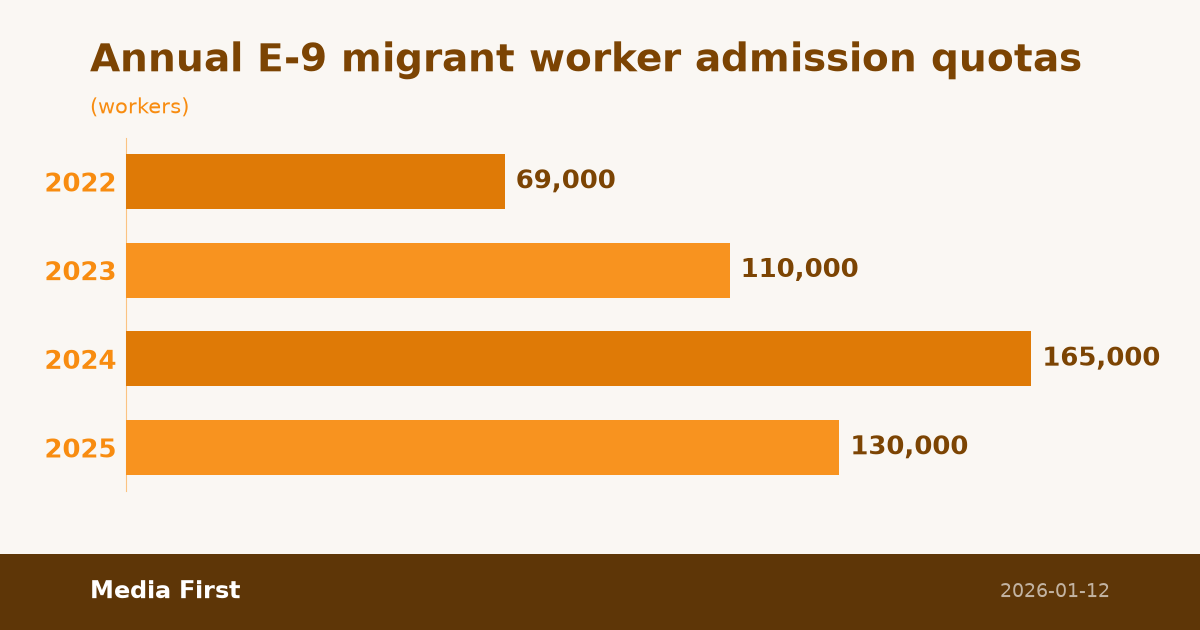
The scale has changed more than the architecture. Annual quotas sat near 50,000 in the early 2020s, then rose sharply as border closures unwound and shortages surfaced: about 69,000 for 2022, 110,000 for 2023 and a record 165,000 for 2024, before being trimmed to 130,000 for 2025. Foreign residents passed 2.5 million by the end of 2023, close to five percent of the population.
Where they work explains why the numbers moved. The bulk of E-9 placements go to manufacturing firms with fewer than 300 employees, concentrated in the foundational trades — casting, plating, moulding, welding — where domestic applicants are scarce despite the same legal wage floor, because the binding constraint is conditions and location rather than pay. Agriculture, livestock and fishing depend on it almost completely in some districts, and the shipbuilding recovery of the early 2020s was staffed in large part by foreign welders and fitters. From 2024 the eligible sectors were widened to include restaurant kitchens, hotel housekeeping and mining, an admission that the shortage had moved into services.
The system’s most criticised feature is mobility. A permit holder may change workplaces a limited number of times — broadly three within the initial three-year term — and a change generally requires either the employer’s agreement or proof that the employer was at fault. The National Human Rights Commission and United Nations treaty bodies have repeatedly flagged the restriction; the Constitutional Court upheld it in 2011 as within legislative discretion. The defence is coherent on its own terms: employers pay recruitment, training and housing costs, and quotas are allocated by sector, so unrestricted movement would drain workers toward easier work and defeat the allocation. The objection is equally coherent: a rule that makes legal status depend on an employer’s signature converts an employment relationship into leverage, whatever the surrounding protections say. Housing has been the clearest case — after deaths in makeshift greenhouse dormitories, the labour ministry ruled in 2021 that such structures could not count as employer-provided accommodation.
Temporariness is deliberate rather than incidental. The standard stay runs four years and ten months, extendable to nine years and eight months, both figures set just below thresholds that would open residency claims. A points-based conversion route to a skilled-worker visa exists and was widened considerably in 2023, when its annual ceiling was raised from a token two thousand to thirty-five thousand, but it remains a narrow door out of a system whose default is departure.
That default is now under strain from two directions. Domestically, the integration apparatus — language classes, school support, local multicultural centres — was built around marriage migrants, not around workers who live in industrial districts for a decade without their families. Externally, the competition for the same workers is intensifying: wages in the main sending countries have risen, and Japan legislated in 2024 to replace its own technical intern programme with a scheme that permits job changes. Korea’s system has spent twenty years getting the legal protections broadly right. Its next problem is that rotation, the principle it was built on, is becoming harder to sell to the people it needs.