Why so many older Koreans keep working past retirement
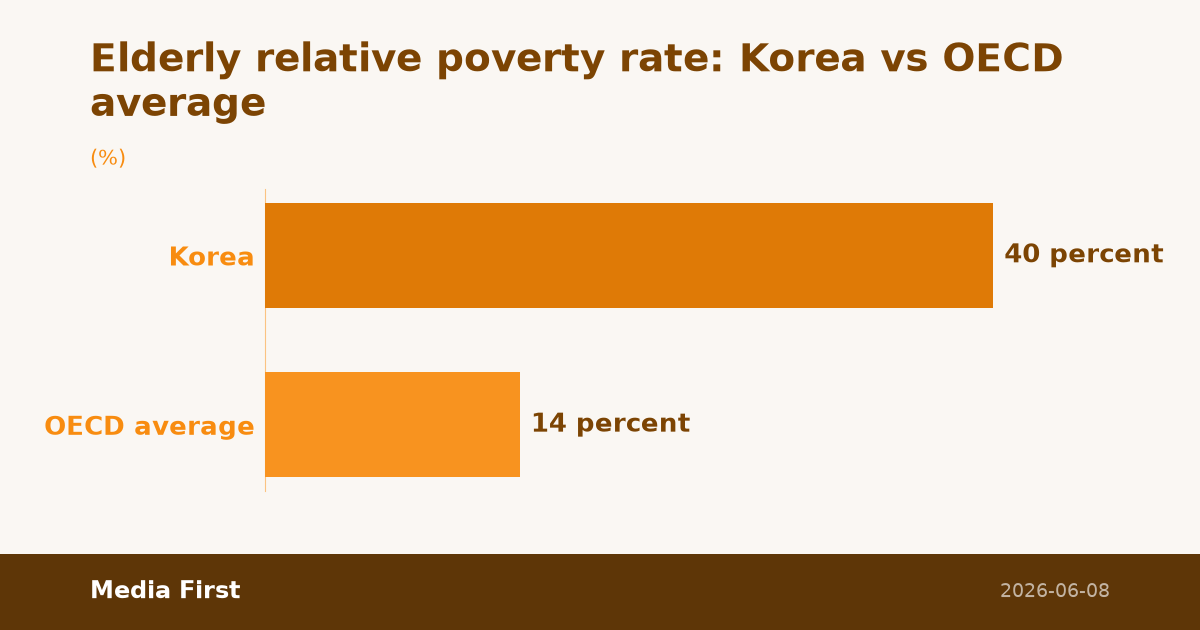
Around four in ten South Koreans over 65 fall below the relative poverty line — by far the highest rate in the OECD — and the country's distinctive answer has been work: more than a third of its seniors hold jobs.

The security guard at a Seoul apartment complex, the delivery cart pushed through a market alley, the highway toll attendant — older workers are so visible in Korea that visitors often remark on it before seeing the statistic that explains it. Around 40 percent of Koreans aged 66 and over live below the relative poverty line, according to OECD comparisons from the early 2020s, against an OECD average near 14 percent. No other member country comes close, and the employment rate among over-65s — more than one in three — is correspondingly the bloc’s highest.
The gap has a specific history rather than a cultural explanation. Korea built its public pension late: the National Pension Service began only in 1988 and reached universal coverage in 1999, which means the current elderly generation spent much or all of their working lives contributing partially or not at all. Average benefits remain modest — a few hundred thousand won a month for many recipients, well short of a minimum living cost in a Korean city. The tax-financed basic pension, paid to the bottom 70 percent of seniors at roughly 330,000 won a month by 2024, softens the floor without raising it far.
The generation now old also spent its savings in a particular way: on children. The families who financed Korea’s education miracle — tutoring, university, marriage funds, apartment deposits — ran down assets on the expectation, reasonable in their parents’ era, that children would support them in turn. That informal contract weakened within a single generation, as nuclear households replaced extended ones, leaving many elderly with neither accumulated pensions nor the filial transfers the old system assumed.
Work fills the gap, but on unfavourable terms. Korean firms customarily retire employees around age 60 — often earlier in practice — after which re-employment means a step down into security, cleaning, delivery and other minimum-wage service work. Government senior-jobs programmes, which subsidise light public-service work for hundreds of thousands of participants, function as welfare in employment’s clothing. The result is a labour market where the counterpart of high senior employment is low senior earnings — activity without security.
Reform moves slowly because every lever is expensive or contested. Raising pension contributions burdens a shrinking working generation already anxious about the scheme’s long-run finances; lifting benefits deepens the same hole. Extending the retirement age collides with a seniority-pay system that makes older workers costly, so employers resist unless wages can be reset — the “peak wage” bargain that unions distrust. Each proposal is, at bottom, a negotiation between generations conducted through fiscal policy.
The arithmetic, however, has a direction. The elderly share of Korea’s population passed one-fifth in the mid-2020s and is headed higher on the fastest ageing curve in the OECD, while the cohorts that will pay for any settlement grow smaller each year. Elderly poverty is often described as a legacy problem — the cost of building a welfare state after the growth, instead of during it. It is also a preview of the fiscal choices every fast-ageing economy will eventually face, taken here first and in public.