K-beauty went back to record exports without the conglomerates
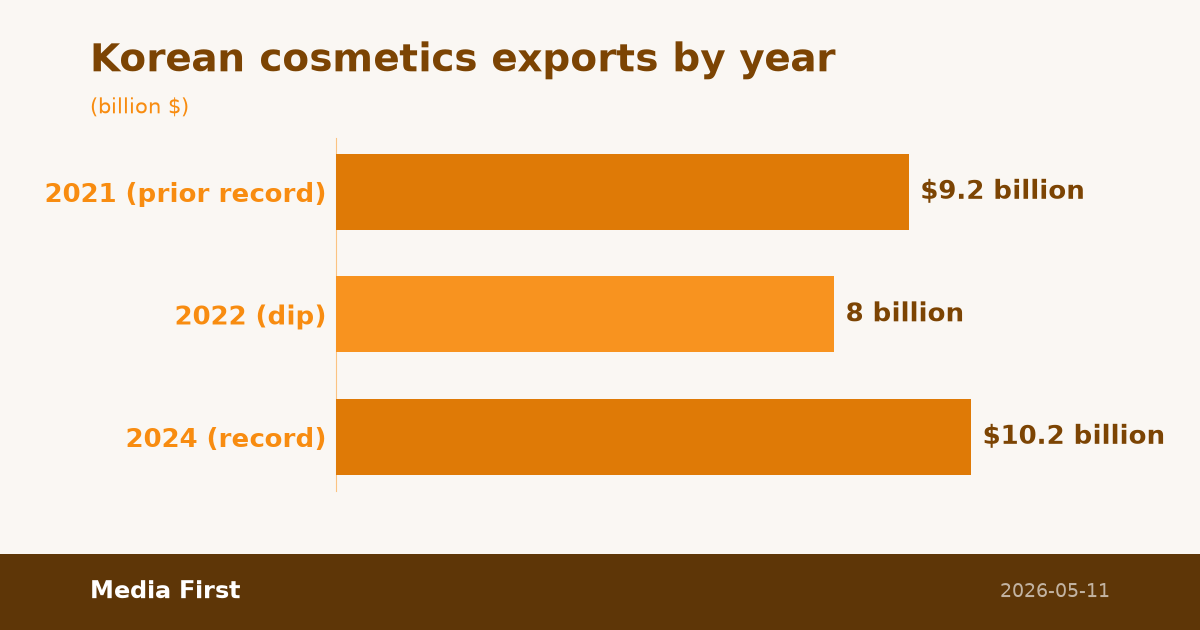
Korean cosmetics exports reached about $10.2 billion in 2024 on the back of small brands and contract manufacturers rather than the industry's traditional leaders.
Korean cosmetics exports reached roughly $10.2 billion in 2024, on customs data, surpassing the previous record of about $9.2 billion set in 2021 and recovering fully from the dip to just under $8 billion in 2022. The headline resembles the first K-beauty boom of the mid-2010s. The structure underneath does not. The earlier wave was built on two large conglomerate brand houses selling into China through duty-free counters and the daigou resale trade. The second wave has been built by companies most Korean consumers cannot name.
The China dependence is the clearest break. Chinese demand supplied the great majority of export growth in the 2010s, and its reversal, driven by domestic Chinese brands taking share, the collapse of the duty-free resale channel and a general downgrading of imported premium beauty, is what produced the 2022 contraction. China remained the largest single destination in 2024, at roughly $2.5 billion, but its share of the total has fallen by more than half from the peak. Shipments to the United States, meanwhile, rose above $1.9 billion, growing at a rate that has put it within reach of the top position on some months of customs data. Japan and Southeast Asia added a third and fourth leg.
What made that substitution possible is a manufacturing structure Korea spent two decades building for other reasons. Korean original design manufacturers, of which the two largest are the dominant global players in the category, will develop a formulation, source packaging, handle regulatory filings and produce at low minimum order quantities. A brand can therefore be a small team with a point of view, a marketing budget and no factory. That collapses the capital requirement for launching a cosmetics label from a manufacturing decision to a working-capital decision, and it compresses the time from concept to shelf to a few months.
The distribution change completed it. A small Korean sunscreen or serum brand can now reach an American customer through Amazon without a distributor, a retail buyer or a single door of shelf space, and can create demand for it through TikTok, where beauty routines are among the most reliably performing content categories and where the format rewards precisely the demonstrable, ingredient-forward product a Korean ODM is good at making. Several Korean indie labels have held top positions in Amazon’s beauty rankings, in categories where the incumbents are multinationals with marketing budgets orders of magnitude larger. The domestic health-and-beauty chain that functions as Korea’s tastemaking gatekeeper serves as the proving ground; success there is now read overseas as a quality signal.
The vulnerabilities in the model are the mirror image of its strengths. A brand with no factory has no moat: the same contract manufacturer will produce a near-identical formulation for a competitor, and it frequently does. A brand built on a platform’s recommendation algorithm is exposed to that algorithm changing, and to the platform’s own regulatory position in its largest market. Concentration risk has moved rather than disappeared, from one country to a small number of channels. And the American market carries tariff and cosmetics-regulation exposure that the China trade never presented in the same form.
For the Korean trade account, the significance is out of proportion to the dollar figure. Ten billion dollars is a fraction of semiconductor exports. But it is earned by hundreds of small firms rather than a handful of large ones, it converts design and marketing rather than capital equipment into foreign currency, and its supply chain, from ODM to packaging to logistics, is largely domestic. It is one of the few Korean export categories where a company with thirty employees can meaningfully participate, which is not a description that fits chips, ships, cars or batteries.