How one port complex became the hinge of Korea's export economy
Busan's rise from a wartime refuge to Northeast Asia's dominant transshipment hub explains a great deal about how Korea's trade-dependent economy actually works — and where it is exposed.
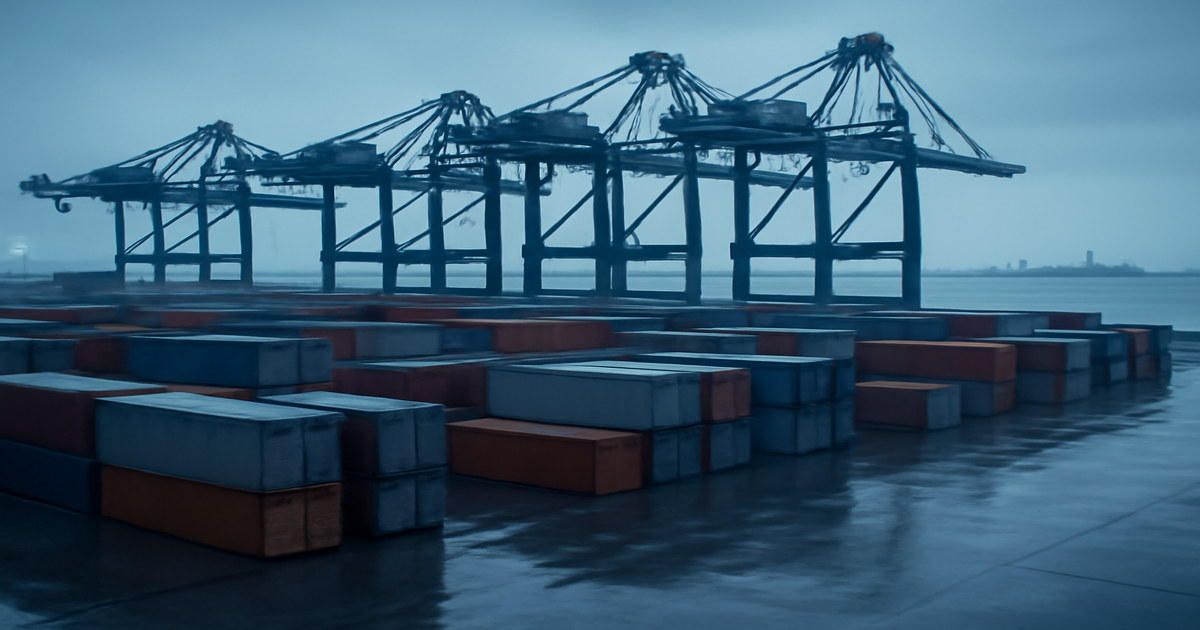
Almost every abstraction used to describe the Korean economy — export-led growth, trade dependence, the manufacturing miracle — becomes physical at a single stretch of coastline in the country’s southeast. Steel coils, petrochemical resins, semiconductors, auto parts and lithium-ion cells converge on Busan, are lifted into standardized boxes, and leave. The country has other ports, and they matter: Gwangyang for steel and bulk, Ulsan for petrochemicals and crude, Incheon for the short China trade and consumer goods, Pyeongtaek-Dangjin for vehicles. But container shipping concentrates ruthlessly, because carriers want the largest ships calling at the fewest terminals, and in Korea that logic has funneled almost everything into one metropolitan port complex.
Geography did much of the work. Busan sits on a deep, sheltered bay near the mouth of the Korea Strait, close to the great-circle routes that link northern China and the Russian Far East to North America. A ship sailing from Qingdao or Dalian toward Los Angeles loses very little time by touching Busan; one calling at Shanghai and then doubling back loses more. That small geometric advantage compounds into a network effect. Because many mainline ships call, many feeder services find it worthwhile to call, and because feeders call, more mainline capacity follows. This is why a substantial portion of the boxes crossing Busan’s quays never enter the Korean economy at all — they arrive from smaller Chinese, Japanese and Russian ports and depart on someone else’s vessel.
That transshipment business quietly reshaped Japan’s port map as well. Cargo from cities along Japan’s Sea of Japan coast has for years found it cheaper and faster to reach the world through Busan than through Tokyo or Yokohama, a fact that periodically produces anxious policy reviews in Tokyo. It is a reminder of what Busan actually sells: not access to Korean consumers, but access to a schedule. Hinterland cargo — the exports of Korean factories — is sticky and comes to the port because it has nowhere else to go. Transshipment cargo is footloose. It follows price, crane productivity and alliance strategy, and it can be lost to a rival hub in the space of a contract cycle.
The physical response to that pressure was the New Port, built westward toward Jinhae Bay from the early 2000s, with deeper berths and larger gantry cranes designed for vessels that had outgrown the old North Port’s constraints. The result is a two-part city: an aging inner harbor being converted into waterfront redevelopment and cruise facilities, and a sprawling, semi-automated container complex further out, connected to the national road and rail spine that runs up the Gyeongbu corridor toward Seoul. That corridor is itself part of the port’s competitiveness, and part of its fragility, since disruptions in the trucking sector propagate to the quay within days.
Institutional history matters too. The creation of a dedicated port authority in the mid-2000s shifted Busan from a directly administered government facility toward something closer to a commercial landlord port, competing for carrier business. The collapse of Hanjin Shipping in 2016 demonstrated how tightly the port’s fortunes are bound to the corporate health of national carriers and to the shifting composition of global shipping alliances, whose reshuffles can redirect enormous volumes with little warning.
The strategic question is what happens as Chinese ports build out their own deep-water hub capacity and as automation changes the labor economics of terminal work — a subject of persistent friction with dockworkers’ unions. Busan’s answer has generally been scale and reliability rather than cheapness. Whether that holds is also a domestic political question, since the port anchors arguments for treating the southeast as a genuine second economic pole rather than a periphery of the capital region.