Why shorter conscription terms are pushing Korea toward a different kind of army
Successive cuts to Korea's mandatory service terms, layered on top of shrinking birth cohorts, are quietly dismantling the manpower assumptions that the country's conscript army was built on.
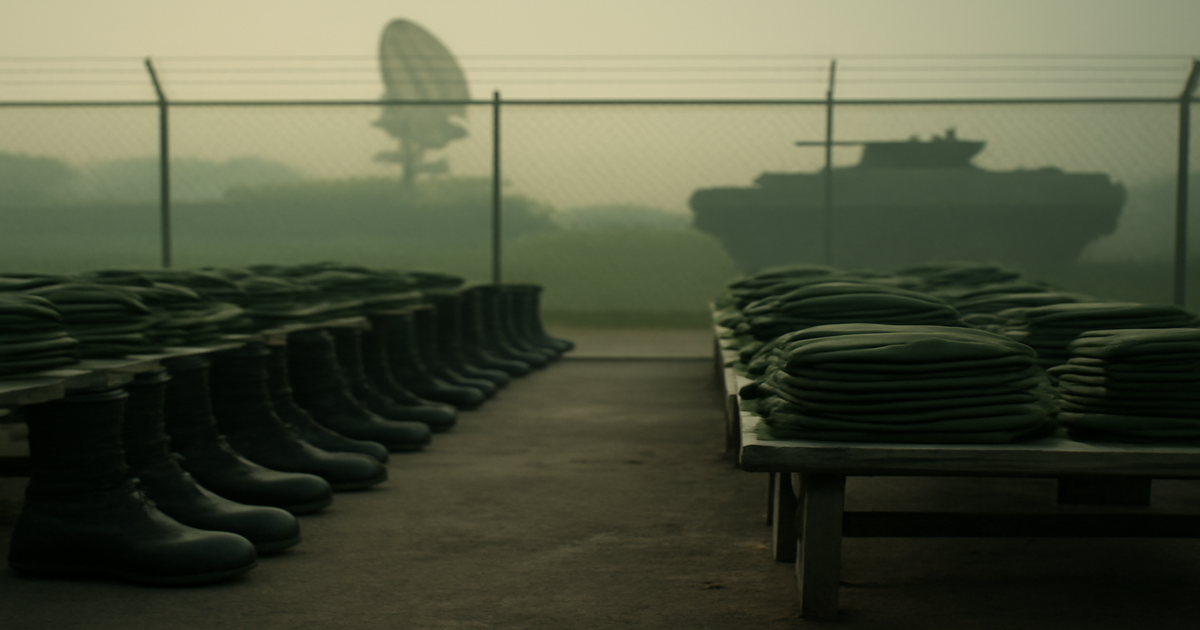
Korea’s conscription terms have been shrinking for decades, and the reductions have almost always been announced as a gift to young men rather than as defense policy. Army service, which stretched close to three years in the decades after the Korean War, was trimmed repeatedly through the 1990s and 2000s and now sits at roughly eighteen months, with navy and air force terms slightly longer. Each cut was popular, each was framed as modernization, and each was implemented without the public acknowledging the arithmetic underneath: the size of a conscript army is simply the annual intake multiplied by the length of service. Halve the term and, all else equal, you halve the standing force drawn from that cohort.
That arithmetic is why demographic decline and service-term policy cannot be discussed separately. Korea’s birth cohorts have contracted sharply since the 1990s, and the men now reaching enlistment age were born in years when the country was already well below replacement fertility. The military is therefore being squeezed from both ends at once — fewer bodies entering, and each body staying for less time. The Defense Ministry has responded by lowering its target for total active-duty strength toward roughly half a million and by raising the share of professional non-commissioned officers and volunteer soldiers, but professional soldiers cost several times what a conscript costs, and the defense budget competes with pensions and healthcare in a rapidly aging state.
The less visible consequence is qualitative. A conscript army with long terms can afford to train slowly; the recruit who spends a year becoming competent still has two more years of usefulness. An eighteen-month term compresses that curve brutally, particularly for anyone assigned to maintain radar, fly drones, manage networks or operate armored vehicles. Units increasingly depend on career NCOs to hold institutional knowledge while conscripts rotate through as assistants, which inverts the old model in which conscripts were the army and cadres merely led them. Recruiting those NCOs has become its own problem, since the same small cohorts are being courted by employers, and military service remains a low-prestige career path for young Koreans with options.
At the same time, the conscription system has been absorbing people it once rejected. Physical and psychological standards have been relaxed over successive revisions, so a very high proportion of medically examined men are now judged fit for active duty, and the industrial and research alternatives that once diverted skilled draftees have been narrowed. Conscientious objectors gained a legal alternative-service route only after a 2018 Constitutional Court ruling, and that channel is deliberately unattractive, involving long correctional-facility work. The direction of travel is clear: the state is scraping the bottom of the eligible pool rather than shrinking its demands.
This is what makes the fairness debate so combustible. Because the burden falls on one gender and increasingly on a smaller cohort, every exemption becomes a national argument — athletes, classical musicians, K-pop performers, dual nationals. Petitions to conscript women surface regularly and are treated more as a grievance vocabulary among young men than as a serious plan, since a genuinely universal draft would require new facilities, new legal frameworks and, awkwardly, an even larger force than the ministry says it wants. Meanwhile conscript pay has been raised steeply, partly on fairness grounds, which further erodes the cost advantage that made mass conscription attractive in the first place.
What emerges is a model in transition without a declared destination. Korea is edging toward a smaller, more capital-intensive force built on drones, sensors, precision fire and artificial intelligence, while retaining a universal draft whose social meaning — a rite of passage, a period of delayed careers, a shared male grievance — no longer matches its military function. Lengthening terms is politically unthinkable, and abolishing conscription is strategically unthinkable while the North fields a far larger standing army. The likely outcome is neither: a conscript system kept formally intact while the actual fighting capability migrates, year by year, to the professionals and the machines.