The school lunch tray is where Korea settled its welfare argument
Free school meals ended as a universal programme after a decade of fighting, and the pressure has since moved to food costs and the people who cook.
For a few years around 2010, the most contested question in South Korean domestic policy was who should pay for a child’s lunch. The argument was not really about food. It was a proxy for the choice between universal and means-tested welfare, fought at a scale small enough to be legible: either every pupil eats at public expense, or only those whose families qualify do. The universal side argued that means-testing marks children in front of their classmates and that administering the test costs more than feeding the excluded. The selective side argued that public money should not buy lunch for households that can afford it. The dispute peaked in a 2011 Seoul referendum on phased versus universal provision that failed to reach its turnout threshold, and the question effectively stopped being live after that.
Universal free meals then spread province by province through the 2010s, from primary schools upward, until by the end of the decade essentially all pupils in compulsory education across the country ate at public expense, with most regions extending it through high school. It is now unusual to hear the principle disputed at all. That is a substantial thing for a country whose welfare state remains comparatively thin: one programme where universality won outright, is administered without an application form, and has proved politically irreversible.
What replaced the fight over entitlement is a squeeze over cost. A school meal is funded through a per-meal unit price set at the provincial level, split between food ingredients, labour and overheads, and the ingredient portion is a fixed number set in advance for a year. When food prices rise sharply, as they did through 2022 and 2023 across produce, eggs and processed goods, the fixed price does not follow within the year. Nutritionists absorb the gap the only way the structure allows, by substituting cheaper protein, shrinking portions of the expensive items, or shifting the menu toward starch. Parents notice the tray before they notice the budget line, which is why complaints about quality tend to arrive a season after a commodity spike.
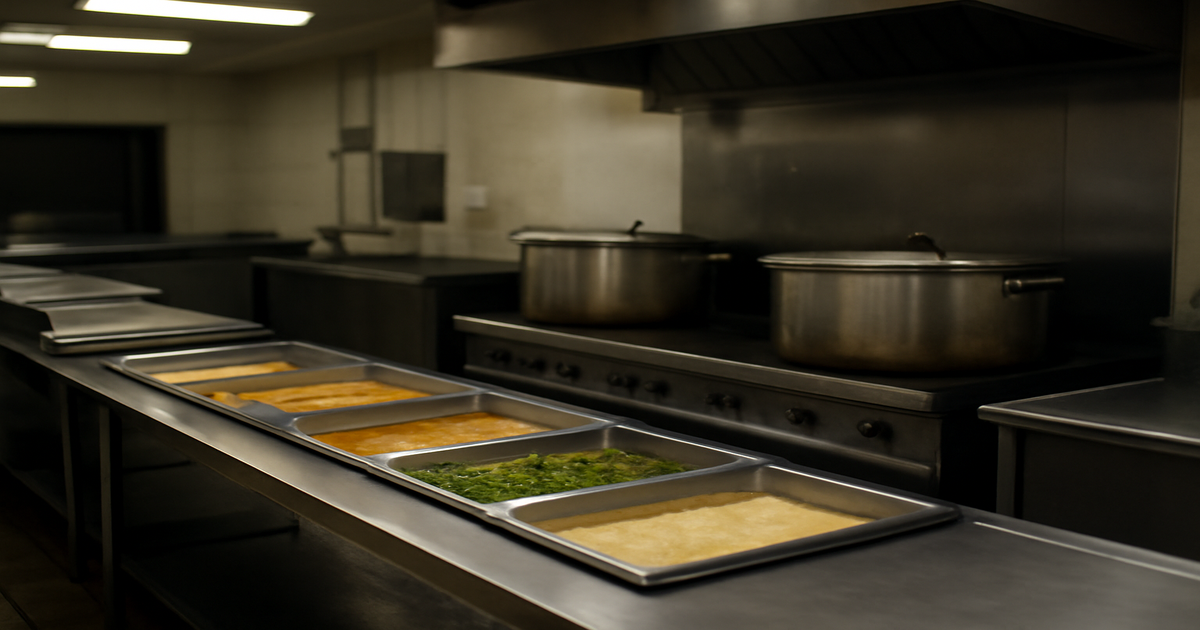
The harder pressure is on staffing. Korean school kitchens run on a small number of cafeteria cooks preparing large volumes of food in a short window, and the staffing standard, expressed as pupils served per worker, is high by international comparison. Union analyses have repeatedly put the Korean ratio at roughly double the Japanese equivalent. The work is physical, concentrated into a few hours, seasonally brutal in an un-air-conditioned kitchen, and paid on a school-support wage scale. Vacancy rates in some metropolitan offices of education have been high enough that schools have had to shorten menus or bring in outside catering for stretches of a term.
Occupational health turned that recruitment problem into something more serious. After the first occupational-disease recognitions of lung cancer in school cooks, the education ministry ran a screening programme for cafeteria staff, and results reported in 2023 from more than twenty thousand workers screened identified dozens of confirmed lung cancers along with a larger number of suspicious findings requiring follow-up. The suspected mechanism is cooking fumes generated by frying and stir-frying at volume in kitchens with inadequate extraction, a hazard well documented in the international literature. Remediation means rebuilding ventilation in thousands of kitchens, which is expensive, slow and difficult to schedule around a school year, and it competes for the same capital budget as everything else a school needs.
So the tray still carries the argument, just a different one. The first version asked whether the state should feed every child, and Korea answered yes with more finality than it has managed on almost any other benefit. The second version asks what that promise is worth in practice, and the answer is set by an ingredient price fixed a year in advance and by whether anyone can be recruited to stand at the fryer. Universality was the cheap part.