Korea's battery makers built for a demand curve that flattened
The three Korean cell makers committed enormous capacity to North America and Europe on the theory that batteries are a scale business, and are now discovering which parts of the memory-chip analogy hold.
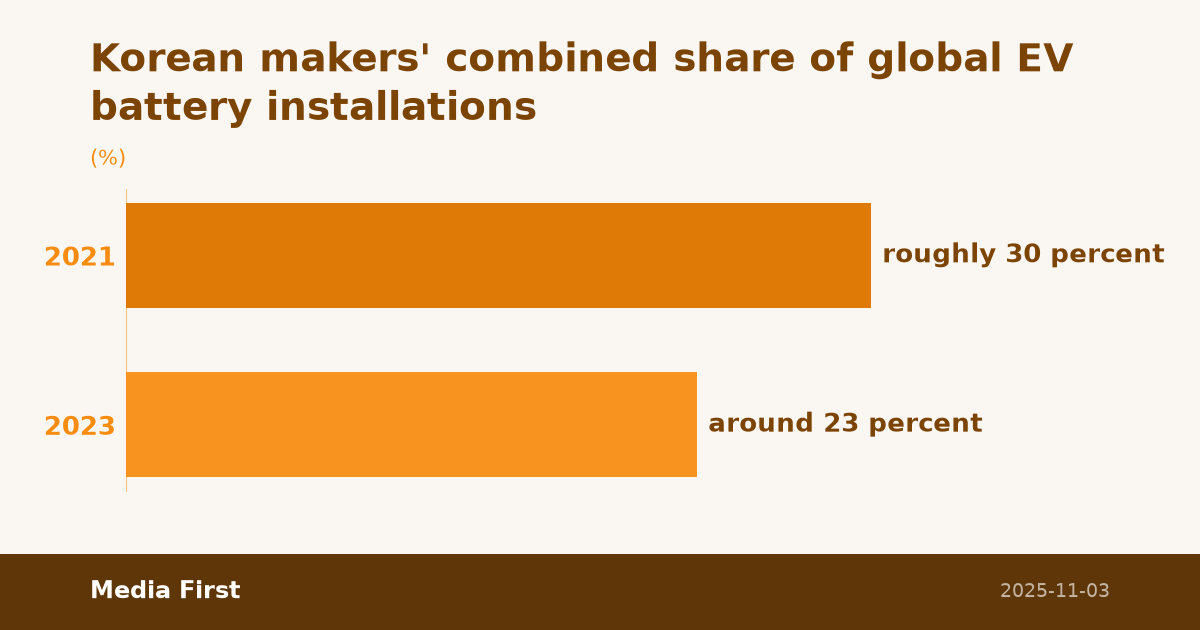
Three companies carry Korea’s position in electric-vehicle batteries: LG Energy Solution, SK On and Samsung SDI. Their combined share of global EV battery installations was around 23 percent in 2023 by SNE Research’s count, down from roughly 30 percent two years earlier — not because their volumes fell, but because Chinese producers grew faster in a market where China itself accounts for most of the units. That single statistic frames the strategic problem. The Korean makers are large, technically strong, and losing relative ground in the segment they helped create.
Their answer was scale, placed close to customers. Over the past several years the three committed to a construction programme across North America and Europe, much of it structured as joint ventures with automakers: LG Energy Solution with General Motors and with Hyundai, SK On with Ford and with Hyundai, Samsung SDI with Stellantis. The United States Inflation Reduction Act, passed in 2022, made the arithmetic work by offering production credits on cells and modules manufactured domestically — a subsidy substantial enough that, for parts of 2023 and 2024, those credits accounted for a large share of the Korean makers’ reported operating profit from their American operations.
Then the demand curve bent. Electric-vehicle sales growth in the United States and Europe decelerated markedly through 2024 as early adopters were exhausted and mainstream buyers balked at price and charging availability. Automakers deferred model launches and pushed back plant timelines, which flowed directly into cell-maker utilisation. SK On, the smallest and most exposed of the three, recorded a long run of consecutive quarterly operating losses. Capacity built for a projection is a fixed cost against a smaller number.
Underneath the cycle sits a harder question about chemistry. Korean producers specialised in nickel-rich cathodes — NCM and NCA — which deliver high energy density and suited the premium vehicles their customers were selling. Lithium iron phosphate is less energy-dense but cheaper, thermally more forgiving and free of cobalt and nickel, and Chinese manufacturers hold a decade of process learning in it. As the market shifted toward affordable models, LFP’s share of global installations rose. The Korean three responded from around 2024 with LFP lines aimed first at grid storage and then at entry-level vehicles, alongside manganese-rich cathode roadmaps, dry-electrode processing and large-format cylindrical cells. Each of those is a credible answer. All of them arrive after the competitor has already climbed the learning curve.
Energy storage is the partial hedge, and an awkward one. Grid-scale storage demand has grown quickly, driven by renewables integration and, latterly, by data-centre power planning. It is also the application where LFP’s cost advantage matters most and its density disadvantage matters least, which means the segment Korean makers are diversifying into is the one most thoroughly occupied by the chemistry they were slowest to adopt.
The upstream picture improved somewhat. The Inflation Reduction Act’s sourcing rules, which restrict credits where components or critical minerals come from designated foreign entities, gave Korean firms a commercial reason to build supply chains outside China — nickel processing in Indonesia, lithium offtakes in Australia and South America, domestic precursor and refining capacity through partners including POSCO. That work is real and slow, and it was undertaken partly because policy demanded it rather than because it was cheaper.
The governing analogy in Seoul has long been memory semiconductors: a capital-intensive commodity business, brutally cyclical, ultimately won by the few firms with the balance sheet to keep investing through a trough while weaker entrants exit. If batteries follow that pattern, the current pain is the price of a position that pays later. The analogy has one weak joint. Memory did not change its fundamental chemistry underneath the incumbents.