Trucks carry most of Korea's freight and the costs show up off the books
Road haulage dominates Korean logistics because of geography, port-centered trade and a fragmented owner-driver labor market — and the resulting congestion, emissions and safety burdens fall largely outside freight rates.
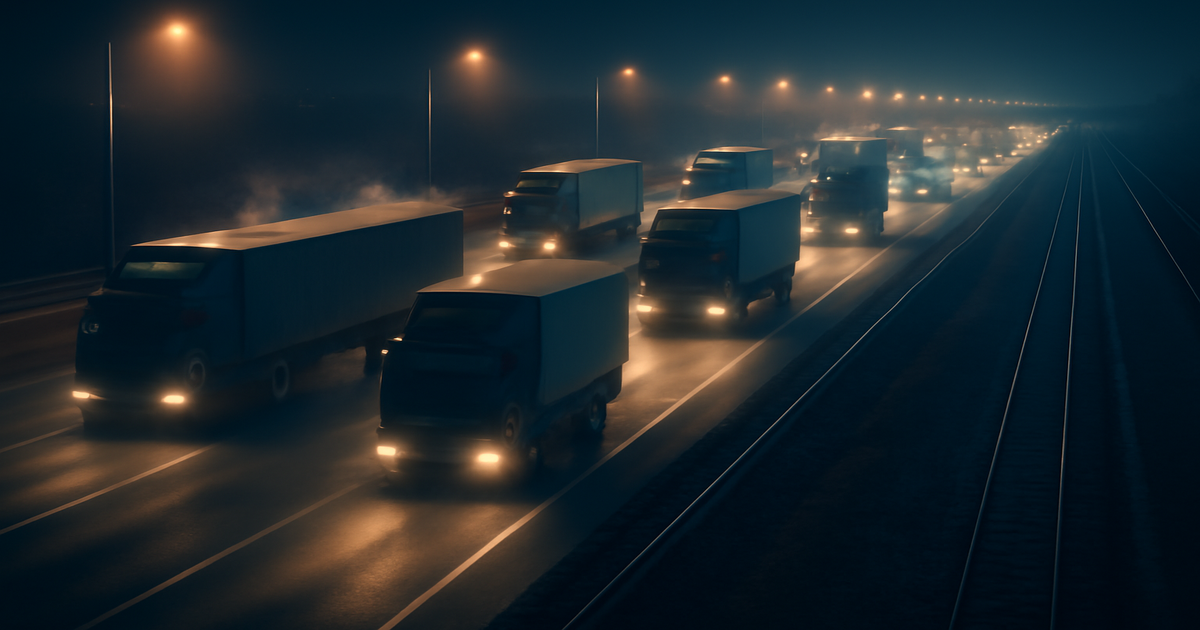
Anyone who has driven the Gyeongbu Expressway between Seoul and Busan at night has seen the shape of the Korean economy: a near-continuous convoy of container tractors and box trucks moving in the right-hand lanes, punctuated by rest areas full of drivers sleeping in cabs. Korea is a manufacturing and export economy with a dense rail network and a state railway operator, yet the overwhelming share of domestic freight tonnage moves on rubber tires. That imbalance is not an accident of policy neglect so much as the accumulated logic of geography, industrial structure and labor arrangements, each reinforcing the others over several decades.
Start with distance. The peninsula’s usable land is short — the trip from the Seoul capital region to the southeastern industrial belt is a matter of a few hundred kilometers, well inside the range where rail’s line-haul economics struggle to overcome the cost of double handling. Rail wins on long hauls where the savings per ton-kilometer can absorb the expense of trucking cargo to a terminal, craning it onto a wagon, and trucking it again at the other end. On a Korean-scale corridor, that first and last mile can eat the entire advantage. Add the fact that most Korean factories, distribution centers and apartment complexes were built without rail sidings, and the default becomes a truck that goes door to door without touching a transfer point.
Industrial organization pushed in the same direction. Korean manufacturing matured around tight just-in-time supplier networks clustered near assembly plants, where parts arrive in small, frequent, precisely timed lots rather than in trainload volumes. Rail is a bulk instrument, well suited to coal, cement, steel and long-distance containers; it is poorly suited to a components run that must arrive within a two-hour window. Meanwhile the country’s trade flows through a handful of ports, above all Busan, and much of that container traffic is transshipment that never travels inland at all. What does move inland often goes by truck because port rail capacity, drayage scheduling and terminal windows make the intermodal option slower and less predictable than the highway.
The rail network itself was optimized for a different purpose. Public investment over the past generation went heavily into high-speed passenger service, and on shared conventional lines passenger trains generally hold priority for slots. Freight gets the residual — often overnight windows, with limited flexibility when a shipment misses its slot. Electrification, tunnel clearances and terminal capacity all constrain what can be carried. A shipper choosing between a mode that is cheap in theory but rigid in practice and a mode that is more expensive per ton but available on demand will usually choose availability.
The decisive factor may be how trucking labor is organized. A large share of Korean heavy trucks are operated by owner-drivers who own or finance their vehicle and work under contract to a licensed carrier, an arrangement long criticized for pushing risk downward. Drivers absorb fuel price swings, vehicle depreciation and idle time, and are paid in ways that reward more trips and longer hours. That makes road freight remarkably cheap to buy and correspondingly punishing to supply — which is why disputes over minimum freight-rate guarantees have repeatedly escalated into national logistics stoppages, and why fatigue-related crashes remain a persistent road safety concern.
The costs of this equilibrium are real but diffuse. Heavy diesel vehicles are a disproportionate source of nitrogen oxides and fine particulates in a country where air quality is a standing public grievance; freight congestion imposes delay on everyone sharing the corridor; and axle loads from heavy trucks drive pavement and bridge maintenance spending funded by general revenue rather than by shippers. None of that appears on a freight invoice. Shifting the balance would require making intermodal service reliable enough to compete on time rather than merely on price — a harder problem than building track.