Social mobility stalls as Korean education mirrors family income
A proverb about dragons rising from streams once described a country where schooling outran birth, and Korea's own spending and attitude surveys now describe something closer to inheritance.

Korean has a proverb for the country’s postwar bargain — a dragon rises from a small stream. For the generation that built the industrial economy, it was closer to description than aspiration. A student from a farming county with no tutors and no connections could sit the same national examination as the son of a Seoul professional, and a good enough score opened the same doors. Education was the instrument that made a rigid society mobile, and belief in it explains much of the intensity Korean schooling is known for abroad.
That belief has been thinning for two decades, and it is measurable. Statistics Korea’s Social Survey, which asks adults whether their children’s generation is likely to move up in social standing, has recorded steadily falling optimism since the mid-2000s; in the 2023 round, well under a third of respondents thought upward movement likely, while a substantial share said the opposite outright. Optimism about one’s own prospects within a lifetime has been lower still. Koreans, in other words, have not stopped valuing education — they have stopped believing it equalises.
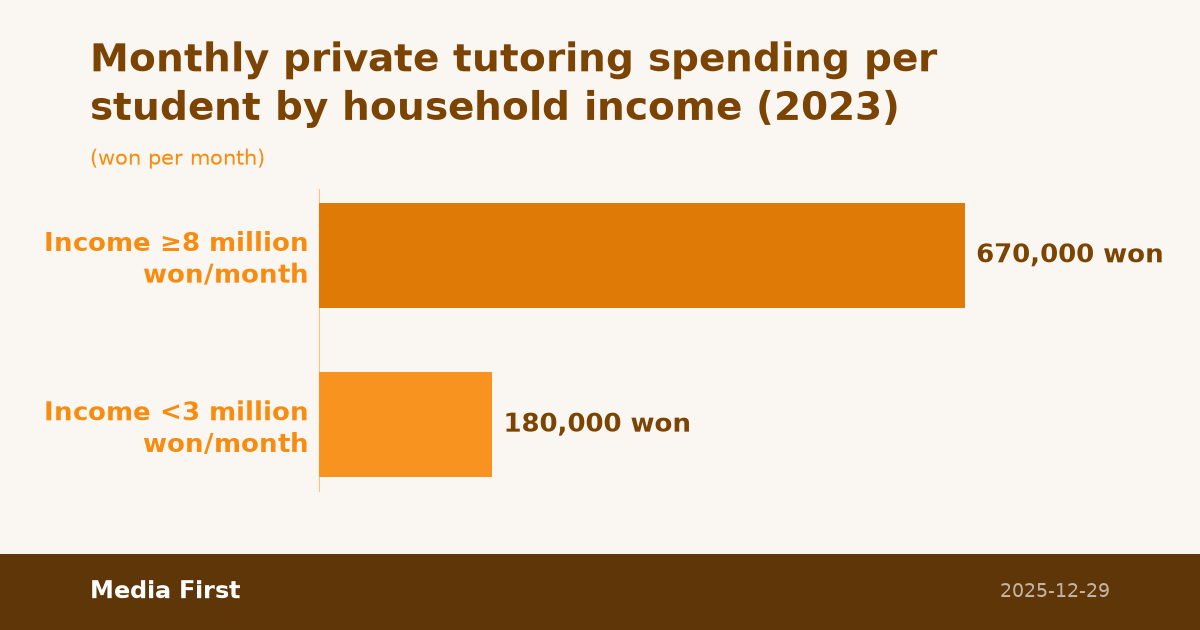
The spending data explain why. Statistics Korea’s annual private education survey, conducted with the education ministry, put total household spending on tutoring at roughly 27 trillion won in 2023, a record, and average monthly spending per student at about 430,000 won. The gradient inside that average is the point: households earning 8 million won or more a month spent roughly 670,000 won per child, against roughly 180,000 won in households earning under 3 million won — a gap of nearly four to one, and one that has widened rather than closed as total spending rose. Preparation for a supposedly neutral examination is bought, and it is bought unevenly.
What that money buys shows up at the destination, though the evidence there is more circumstantial. Analyses of national scholarship applications, which record household income brackets, have repeatedly suggested that students at the most selective Seoul universities come disproportionately from high-income households, and admissions figures released to the National Assembly over the years have shown a handful of affluent districts and a small set of elite high schools supplying a share of those places far out of proportion to their population. Individual figures are contested; the direction is not.
The mechanism is broader than tutoring alone. Housing in the districts with the strongest school reputations carries a price premium that converts income into educational advantage and then back into property wealth. The admission routes based on school records and activities, designed partly to relieve examination pressure, reward families who can decipher a complicated system and support the portfolio it asks for. Even the examination route rewards the capacity to fund a second or third attempt after graduation. Each channel is formally open; each has an entry cost.
Historians of the period add a further complication for anyone hoping to restore the old bargain. Mobility was high in Korea’s growth decades partly because growth itself created new positions faster than existing elites could occupy them; education distributed people into an expanding structure. With growth slower, the pyramid stable, and the rewards concentrated in a narrow band of large-firm and professional employment, the same schooling sorts more than it lifts. The system did not become less meritocratic so much as the merit it measures became more purchasable and the prizes fewer.
Policy has answered at the gate — opportunity-balance admission quotas for low-income and rural applicants, regional intake requirements, free public broadcast lectures, the long tuition freeze, expanded state scholarships. These are real and they matter at the margin. But they redistribute access to a competition whose stakes are set elsewhere, in a labour market that pays very differently depending on which employer’s badge a graduate ends up wearing. Until that spread narrows, Korean families will keep spending exactly as the surveys record, and the dragons will keep coming from the same few streams.