Korean companies' AI use rose sixfold since 2017, but big employers pulled far ahead
The Korea Research Institute for Vocational Education and Training reported that the share of Korean companies using artificial intelligence rose from 1.4% in 2017 to 9.2% in 2024, with the gap between large and small firms widening from 2.8 to 11.8 percentage points.

The share of Korean companies using artificial intelligence climbed from 1.4% in 2017 to 9.2% in 2024, roughly a sixfold increase, but the spread between the largest and smallest employers widened sharply over the same period, according to an analysis published on July 31, 2026 by the Korea Research Institute for Vocational Education and Training.
The findings appeared as the first issue analysis in a special 2026 edition of the institute’s periodical THE HRD REVIEW. The institute said the analysis drew on microdata from the National Data Office’s Survey of Business Activities covering 2017 to 2024, examining incorporated companies with at least 50 regular employees and capital of 300 million won or more. That yielded roughly 12,000 to 15,000 firms observed each year and 106,389 observations in total. A company was counted as using AI when its reported AI adoption stage was anything other than “not applicable.”
Adoption accelerated late in the period, rising from 4.3% in 2022 to 6.1% in 2023 and 9.2% in 2024, the institute said. Broader digital adoption was more common: 22.3% of firms used at least one of eight fourth-industrial-revolution technologies such as the internet of things, cloud computing, big data and AI, a share 13.1 percentage points higher than the AI-only figure.
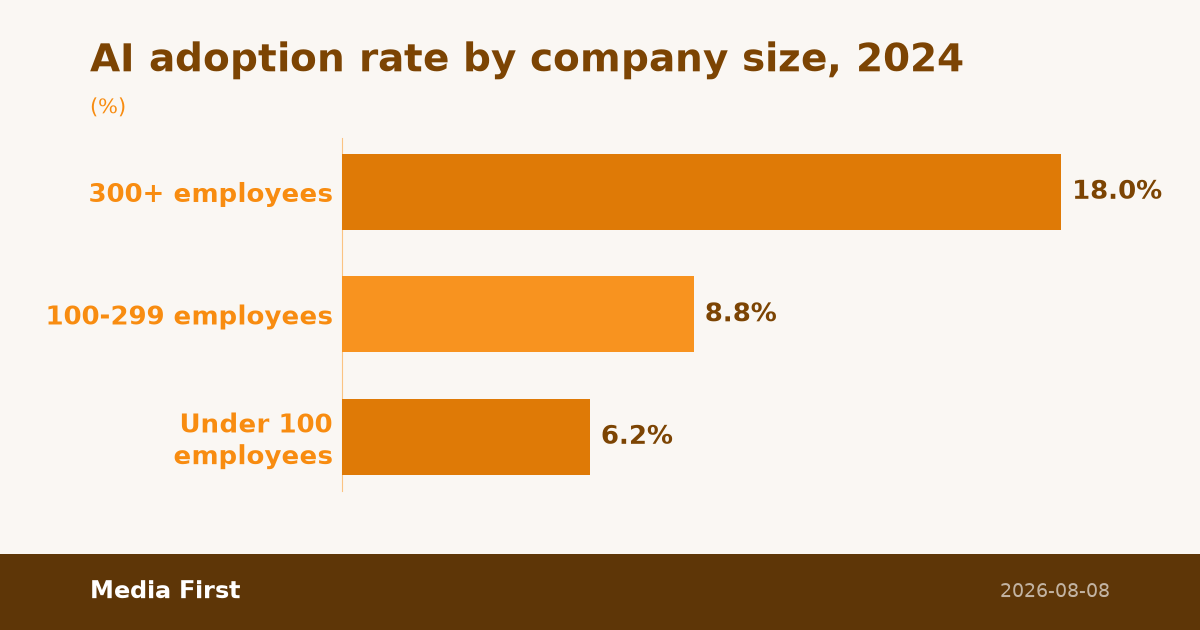
The divide by company size was the study’s central finding. Firms with 300 or more employees moved from 3.5% adoption in 2017 to 18.0% in 2024, while those with fewer than 100 employees went from 0.7% to 6.2% and firms with 100 to 299 employees reached 8.8%. The resulting gap between the largest and smallest categories grew from 2.8 percentage points to 11.8 percentage points.
Adoption also clustered by sector. Information and communications led at 34.5%, followed by education services at 26.5%, finance and insurance at 21.3%, electricity and gas at 15.5% and professional, scientific and technical services at 11.6%. Manufacturing stood at 5.7%. Among companies using AI in 2024, 59.3% cited product and service development as the purpose, ahead of organizational management at 11.6%, production processes at 10.5%, marketing strategy at 10.1% and sales at 8.5%.
Jeong Ji-woon, a senior research fellow at the institute, said support for smaller companies should combine vouchers, expert consulting, shared-use infrastructure and workforce training, according to the institute. For manufacturing, the analysis recommended linking AI adoption to existing digital foundations such as smart factories and strengthening the AI and data skills of incumbent workers.
The institute noted the work is descriptive statistics and does not capture the intensity of AI use, investment size, technology type or performance outcomes. The Korea Research Institute for Vocational Education and Training is a government-funded research body established in 1997 under the Office of the Prime Minister and is headed by President Ko Hye-won.