Why Korea keeps finishing last among rich countries on happiness
Korea's position in the fifties in global life-evaluation rankings sits far below its income rank, and the components that pull it down are social support, freedom and time rather than money.

The World Happiness Report, published annually since 2012 by an international research team using Gallup’s world survey, ranked South Korea 52nd out of 143 countries in its 2024 edition, with a life-evaluation score just above six on a ten-point scale. Finland occupied first place for the seventh consecutive year. Korea’s placement has moved within a band roughly between the low fifties and the low sixties for a decade — respectable against the global distribution, and conspicuously poor against the group of countries with comparable income. Korea’s GDP per capita, above 33,000 dollars, sits inside the world’s top thirty; its life-evaluation rank does not come close.
The gap invites misreading, so the method matters. The ranking is not an index built from social indicators but an average of a single survey question — the Cantril ladder, which asks respondents to place their present life on a ladder from zero to ten. The six familiar variables — income per head, social support, healthy life expectancy, freedom to make life choices, generosity and perceived corruption — are used afterwards to explain differences between countries, not to compute the score. Korea’s profile in that explanatory exercise is lopsided: near the top of the world on income and on healthy life expectancy, which exceeds 83 years, and well down the table on the relational measures.
The single most consistent weakness is social support, measured by asking whether respondents have relatives or friends they could count on in trouble. Korea’s affirmative rate has been among the lowest in the OECD since the organisation began publishing the comparison in the mid-2000s, and the finding has proved stubborn across surveys and years. Generalised trust — the share saying most people can be trusted — is similarly below the OECD average in comparative work. These measure neither poverty nor public services, both of which Korea supplies at a rich-country standard. They measure whether people believe someone is there.
One explanation that recurs in Korean scholarship is the density of comparison. Positional goods — status that exists only relative to others — cannot be increased in aggregate, so a society that channels a large share of its aspiration into them converts growth into competition rather than satisfaction. Korea supplies an unusual amount of legible ranking: a single national entrance exam, a hierarchy of employers sorted into tiers everyone can name, apartment complexes whose brand and district function as published scores. Income inequality here is not extreme by OECD standards; the salience of comparison is what stands out, and salience is what research on relative income says drives dissatisfaction.
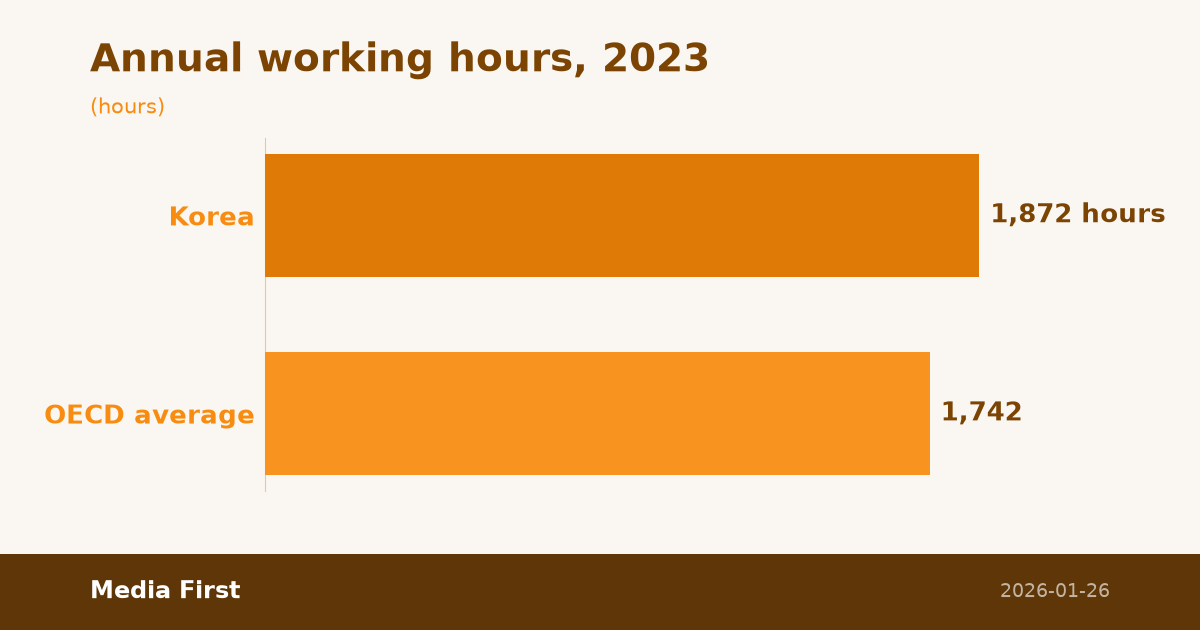
Time is the other input. Koreans worked about 1,872 hours in 2023 against an OECD average near 1,742, a gap much narrowed from the 2000s but persistent, and hours are the raw material of the relational goods the surveys find missing. Age composition compounds it: older Koreans report markedly lower life evaluations than younger ones, and relative poverty among the over-65s has been the highest in the OECD at around 40 percent, a legacy of a pension system that matured after the cohort now retiring had spent its working life.
A frequently omitted caveat belongs here. Self-reported life evaluation is not culture-neutral: respondents in East Asian societies tend to avoid the ends of rating scales, and Japan, Hong Kong and Taiwan also sit below what their incomes would predict. Some unknown portion of Korea’s gap is a response-style artefact rather than a difference in experience, which is reason to treat the precise rank as noise.
What survives that caveat is the internal pattern. Whatever the level, the components move: Korea’s income and longevity scores rose for decades while its social-support and freedom scores did not. That is the finding worth acting on, and it points away from the policy instruments Korea is best at. Building infrastructure and raising incomes are solved problems here. Manufacturing the conditions under which people have someone to call is not a policy with a budget line.