Korea's capital region runs on some of the longest commutes in the OECD
Half the country lives on a tenth of its land and travels a long way to work inside it, the result of building housing on one ministry's timetable and rail on another's.

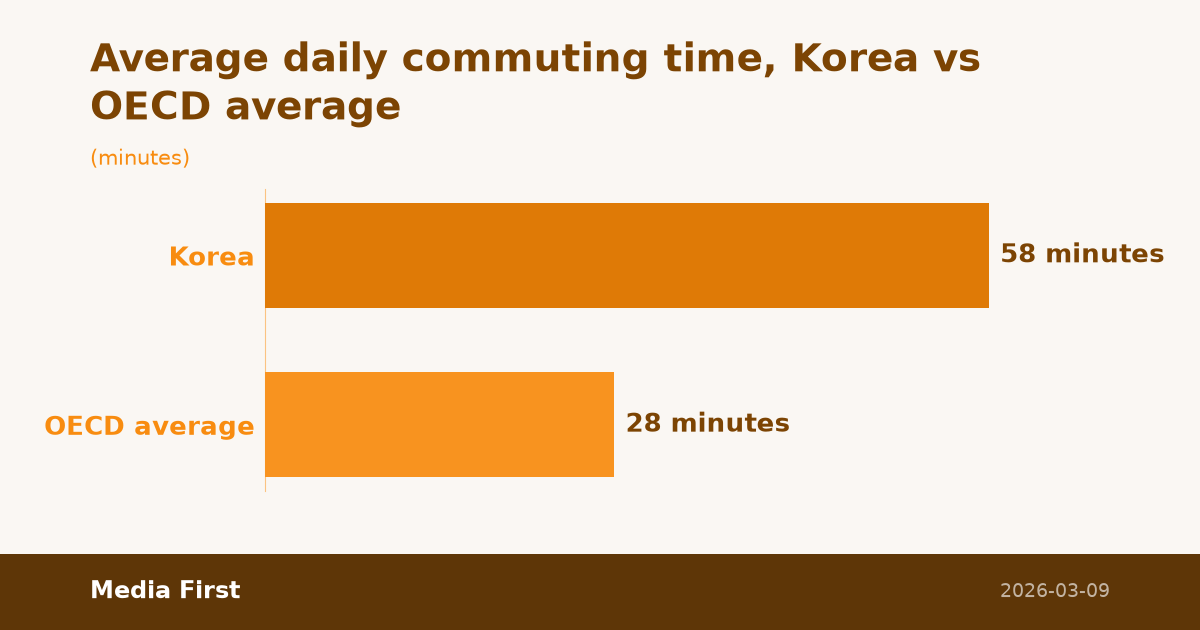
Comparative time-use data collected by the OECD puts the average time a Korean spends travelling to and from work at about 58 minutes a day, against an organisation-wide average close to 28 minutes — the longest in the group. Korea’s own statistics agency, tabulating commuting from the census, has recorded a national average one-way trip around half an hour, with the capital region well above that. The two sources measure slightly different things but agree on the shape: commuting in Korea is unusually long, because of where the capital region put its houses relative to its offices.
The geography is extreme by any standard. Seoul, Incheon and Gyeonggi province together passed half the national population around 2019 and have kept growing, on roughly a tenth of the country’s land area. Employment is concentrated more tightly than residence — Seoul’s daytime population exceeds its registered population, and census tabulations count well over a million people commuting into Seoul each day from Gyeonggi and Incheon. Housing costs pushed households outward for two decades while offices stayed in three or four districts, and the difference is absorbed as travel time.
The sequencing is the specific failure. Korea’s first generation of new towns, designated in 1989 at Bundang and Ilsan, were planned with rail connections as part of the scheme. Several of the second generation, laid out in the 2000s, were occupied years before their rail links opened. The Gimpo light metro, opened in 2019 to serve a district that had been filling since the previous decade, runs two-car trains and became a national shorthand for crush loading. The pattern is institutional rather than accidental: housing is delivered on the land ministry’s construction timetable, rail on a separate budget and appraisal cycle, and nothing forces the two to clear at the same date. Residents arrive first because apartments can be finished in four years and a metro line cannot.
The current answer is express regional rail. The GTX network — deep-bored lines reaching higher average speeds than conventional metro by running fewer stops — opened its first section between Suseo and Dongtan in March 2024, with a northern section later that year and two more lines building toward late-2020s targets. The performance claim is genuine: journeys of over an hour by road are timetabled at around twenty minutes. For the households on those corridors, the change is large and immediate.
Whether it shortens commutes in aggregate is a different question, and the transport economics literature is not encouraging. Faster rail extends the radius from which a job in central Seoul is reachable within a tolerable time, which raises land values along the corridor and makes housing development further out viable. Unless employment disperses at the same time, the likely outcome is not shorter journeys but the same journey times from further away, with more people making them. Japan’s regional rail history offers exactly this pattern. Rail buys travel time; it does not move offices.
The cost of the current arrangement is easier to state than to price. Fifty-eight minutes a day is roughly 230 hours a year, close to six working weeks, spent in a condition that time-use research consistently ranks among the least pleasant parts of the day and that correlates with reported wellbeing more strongly than most equivalent gains in consumption. It is also time subtracted from the activities — seeing friends, family meals, community involvement — on which Korea scores poorly in comparisons of social support. The commute is not merely an inconvenience in that account; it is one of the mechanisms.
The structural fix is job dispersal, and Korea has attempted it before: public agencies were relocated to provincial innovation cities from the late 2000s, with measurable effects on those cities and no measurable effect on capital-region concentration, because corporate headquarters did not follow. Until they do, the capital region’s transport planning is an exercise in moving people faster across a distance that policy created and keeps recreating.