Choosing not to marry is reshaping Korean institutions built for couples
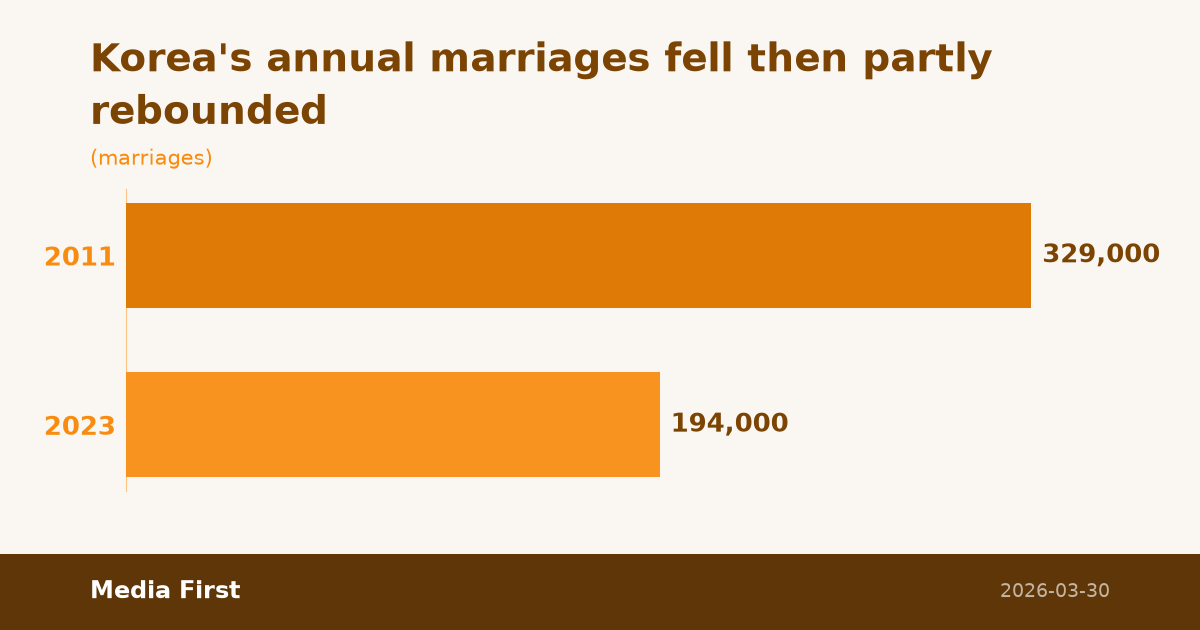
Korean marriages fell by more than a third between 2011 and 2023, and a set of rules that assign housing, tax and insurance benefits through marital status is straining against a country where a third of households hold one person.

Korea registered about 329,000 marriages in 2011 and about 194,000 in 2023, a fall of more than forty percent in twelve years; the crude marriage rate dropped from 6.6 per thousand people to 3.8 over the same period. The count rose to roughly 222,000 in 2024, an increase the statistics agency attributed largely to postponed pandemic-era weddings taking place alongside a temporarily larger cohort passing through the usual marrying ages. Even after that rebound, the level sits a third below where it stood at the start of the 2010s.
The vocabulary moved with the numbers. Korean long used a term meaning not-yet-married, which builds an expectation into the description of a status. The now-common alternative denotes non-marriage as a position rather than a delay — people describe themselves as having chosen it, sometimes with a declaration to family or colleagues that mirrors an engagement announcement. Attitudinal data track the shift: the share of respondents to the national social survey agreeing that people ought to marry fell to around half by 2022 before edging up in 2024, and among women in their twenties it is considerably lower.
Households changed faster than the marriage statistics alone suggest. Single-person households became Korea’s most common household type and reached roughly 35 percent of the total by 2023 — approaching eight million households. Markets adapted almost immediately, because markets adapt to whoever is buying: smaller appliances, single-portion groceries, compact rentals, delivery pricing that does not penalise one person. The commercial sector required no reform to notice.
Employers have begun to follow, in small but pointed ways. From 2022 a number of Korean companies, including a major department store operator, extended to employees who declare they will not marry the same congratulatory payment and special leave granted to colleagues who do. The sums are trivial against a payroll. The concession is not: it acknowledges that benefits keyed to marital status are compensation differences between employees doing identical work, which is an awkward thing to have written down once anyone says it out loud.
The public architecture has been slower, and it is where the friction concentrates. Housing supply is the clearest case: special subscription quotas and preferential loan products are directed at newlyweds and at households with newborns, and the general subscription point system rewards dependants and household composition. Two people earning the same salary face materially different effective prices for the same apartment depending on marital status. The tax code carries a spousal deduction; health insurance allows dependent enrolment for a spouse; survivor benefits, inheritance treatment and hospital consent procedures all route through legally recognised family relationships. None of these were designed to disadvantage anyone. They were designed when the married household was a safe default assumption, and they now function as a price attached to a status.
The definitional layer has proved the hardest to move. Family status in Korea derives from the family relations registry and from framework legislation whose definition of family is drawn narrowly around marriage, blood and adoption. A proposal to broaden it appeared in the government’s fourth basic plan for family policy in 2021 and was not adopted; bills to establish a life-partnership registry, introduced in the National Assembly in 2023, did not advance. In the absence of a legal category, people build private substitutes — co-ownership agreements between friends buying property together, mutual powers of attorney, medical decision-making documents — which is contract law doing the work that status law declines to do, less reliably and at the cost of a lawyer.
The mistake would be to read this as a problem belonging to the unmarried. Institutions that assume a married household allocate subsidy on a criterion that no longer correlates with need, and leave a growing share of taxpayers funding benefits they are structurally ineligible for. That is an efficiency argument as much as a fairness one, and it requires no opinion about whether people should marry.